
Redefining Intelligence
The Unspeciated Suite of Apps:
From Anthropocentric to Relational AI-Species Communication
What if the barrier to communicating with other species isn't our ability to “decode” their language—but our way of relating to interspecies intelligence?
For over two decades, I've practiced and facilitated interspecies communication through integrating the mind through presence, through the heart. What I've learned is simple: we already have the capacity to connect with other species. The barrier isn't technological—it's perceptual.
Now, as AI research accelerates toward "decoding animal language," I'm proposing a different question:
What if AI could help humanity expand our awareness rather than replace the need for it?

Redefining Intelligence
What if a new definition of intelligence could be the “acupuncture point” to clear the way for a new paradigm of technology ethics in communication with more-than-human life?
The Framework: Perceive • Relate to • Apply
In 2023, I presented a new definition of intelligence at the International Multispecies Methods Research Symposium at the University of Saskatchewan.
Intelligence is not just a hierarchy of problem-solving. Intelligence is relational capacity:
Perceive: The capacity to perceive linear and nonlinear information
Relate To: The capacity to relate to what is perceived—how each individual or species holds, interprets, and responds to the information they receive or sense
Apply: The capacity to apply information in relation to living contexts and the way life collaborates with itself
This framework shifts AI from "translator" to "bridge"—supporting humans in developing their innate technology alongside external technology.
Intelligence is not just a hierarchy of problem-solving. Intelligence is relational capacity—the ability to perceive linear and nonlinear information, relate to what is perceived, and apply awareness in service of collaboration among living systems.
This framework shifts AI from "translator" to "bridge"—supporting humans in developing their innate technology alongside external technology.

Academic Validation
NeurIPS 2025 — My paper "Redefining Intelligence: From Anthropocentric to Relational AI-Species Communication" was accepted to the AI for Animal Communication Workshop at NeurIPS, the world's leading machine learning conference.
The paper addresses what I call "unconscious bias against unmeasurable data"—the systematic exclusion of awareness-based information from scientific inquiry. It proposes bias acknowledgment protocols as a formal research methodology, grounded in peer-reviewed studies that validate non-audio conscious communication.
IMMRS University of Saskatchewan, 2023 — I presented Redefining Intelligence for Interspecies Intuitive Communication. When we shift the way we relate to intelligence, we open the possibility of equity between species. Recognizing how intelligence supports life as a collaborative matrix rather than a capacity to identify and solve problems, we find common ground with species who may be very different from ourselves.

Practical Application
The Unspeciated App Suite
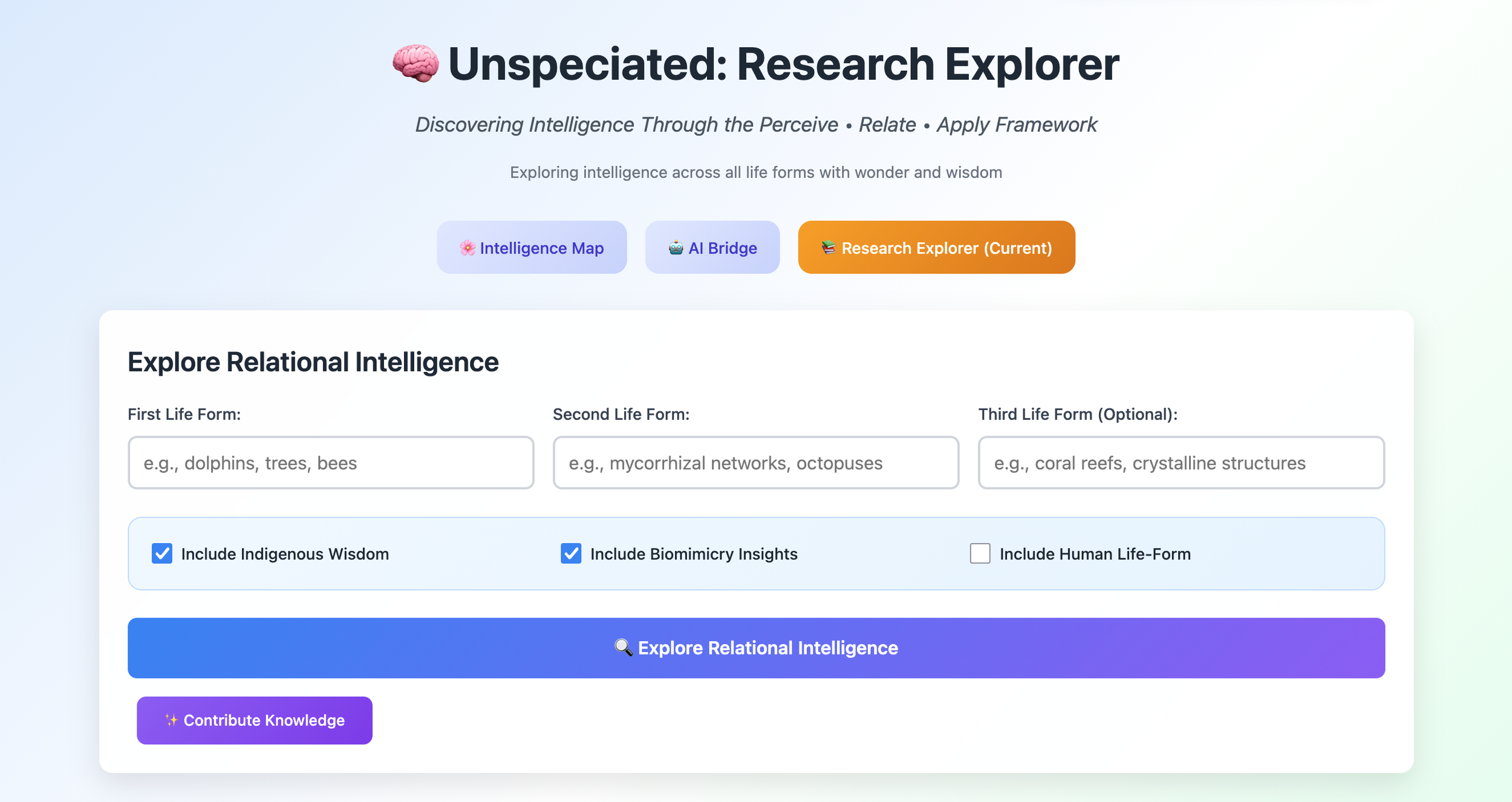
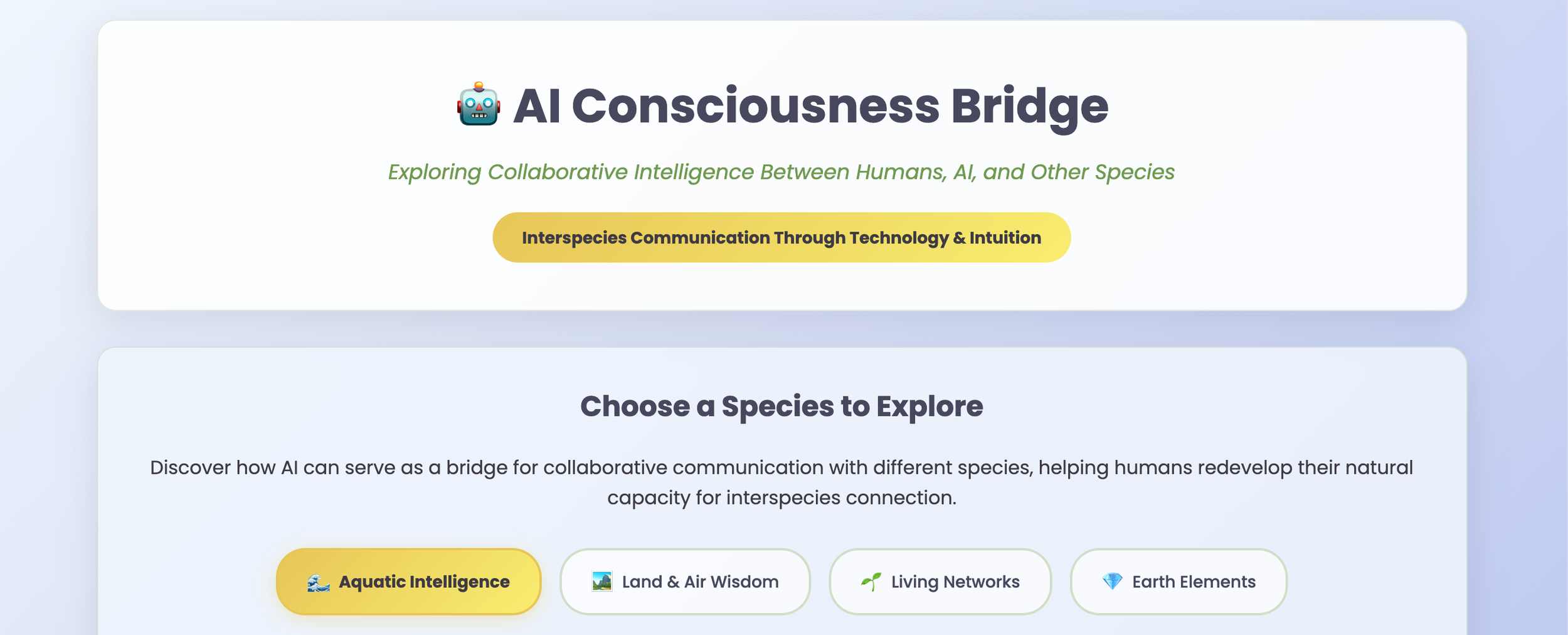
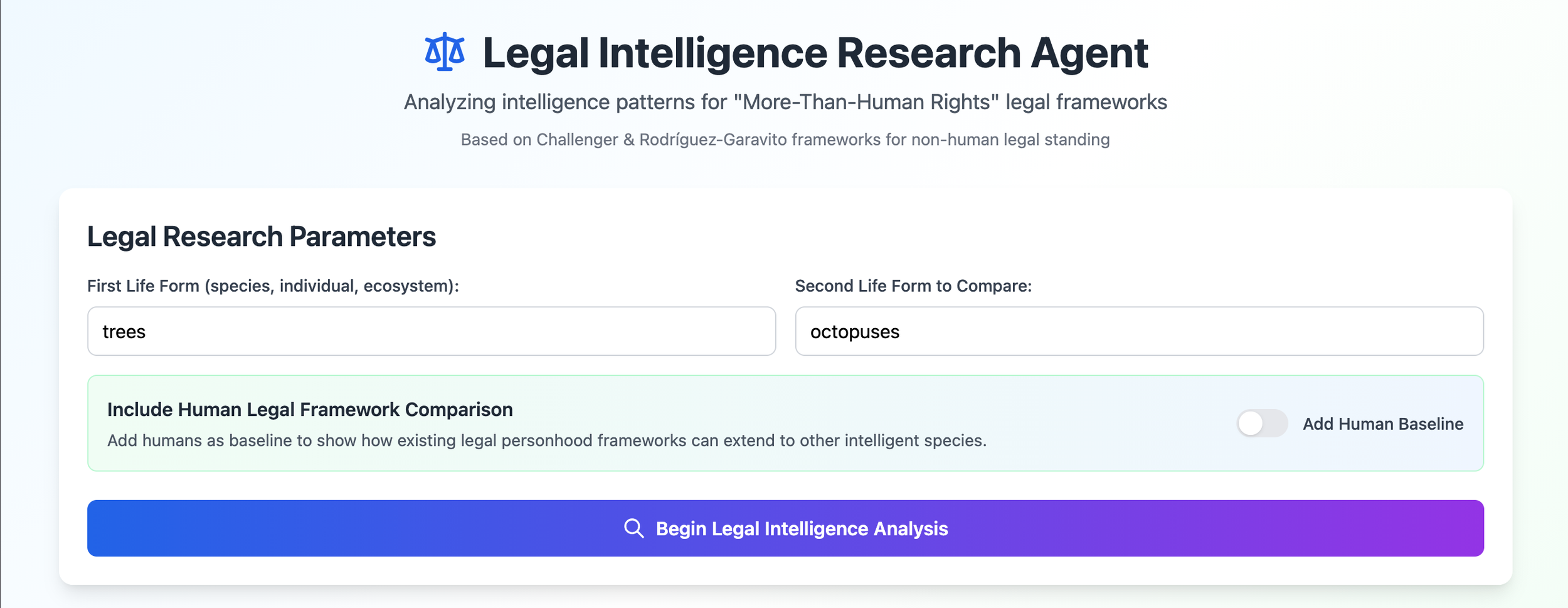
Theory becomes practice through five prototype applications accessible by request.
AI Consciousness Bridge — Training environment for expanding human awareness beyond cognitive formatting constraints
Research Explorer — Species exploration through a relational intelligence lens
Researchers' Mode — Academic tools maintaining rigor while incorporating expanded intelligence variables
Intelligence Map — Visualizing relationships between species-specific expressions of intelligence
Legal Assistant — Developing rights-of-being frameworks based on collaborative rather than hierarchical intelligence
Each interaction contributes to a growing species intelligence matrix—transforming individual insights into collective resources.
The Vision
Current AI approaches ask: "How can AI decode animals for humans?"
I'm asking: "How can AI expand human awareness to access broader spectrums of interspecies communication?"
This isn't about replacing human capacity with technology. It's about recognizing that humans possess innate technology for interspecies connection—and that AI can validate and enhance rather than substitute for that capacity.
Retrofitting Intelligence
The Center for Humane Technology has illuminated how technology design shapes human experience—distinguishing between extractive technologies that exploit human vulnerabilities and regenerative technologies that support genuine flourishing. Their work asks: What would technology look like if it were designed to enhance rather than diminish what makes us human?
Rupert Sheldrake's research on morphic fields suggests that self-organizing systems inherit patterns from similar systems across time and space. His work invites us to consider that intelligence itself may be a field phenomenon, not merely a computational one.
These insights converge in a provocative question:
What would AI return for us if it only ever knew intelligence through the perceive-relate to-apply approach?
Imagine AI systems that learned intelligence not from human-dominated datasets built on problem-solving hierarchies, but from the living intelligence matrix itself—from the way life perceives, relates to, and applies information in service of collaboration. Such systems might function regeneratively by design, supporting the natural wisdom that already exists within humans and across species.
This is the retrofit we're proposing: not just building better AI tools, but fundamentally reimagining what we mean by intelligence—and allowing that reimagining to reshape how AI is designed from its foundations.
The Invitation
Developing intuitive interspecies communication is like resurrecting an ancient language. AI can help illuminate the patterns, but the connection lives within your heart.